

A missed task is an annoyance in most industries. In fintech, a missed compliance sign-off before a payments release can end up in front of a regulator.
That difference is why so many fintech project managers feel let down by their tools. The work is regulated, shared across several teams and often across several companies. The software running it was usually designed with a marketing campaign in mind.
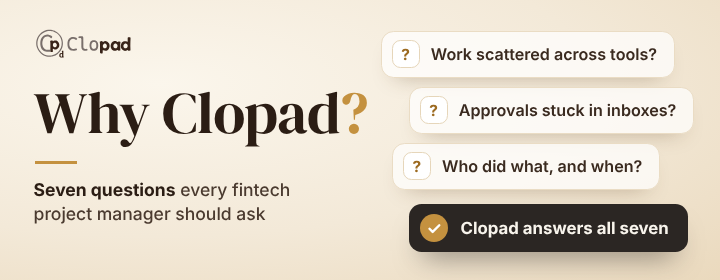
Clopad is fintech project management software built for the first kind of work. It keeps projects, tasks, tickets and approvals in one secure workspace. Rather than walk you through a feature list, this post asks six questions about how your team works today. If any of them feel uncomfortably familiar, you’ll see how Clopad answers each one.
1. Is your team’s work scattered across email, spreadsheets and chat?
A new payment partner integration kicks off. The requirements sit in an email, the timeline in a spreadsheet, the bugs in a ticketing tool and the decisions in a chat thread from three weeks ago. Nothing is lost, exactly. It just takes twenty minutes to find.
That hunting adds up over a week. Every switch between tools costs attention, and every copy of the same information is a chance for two versions of the truth.
Clopad puts all of it in one workspace. Projects hold the bigger initiative, tasks break it into owned pieces of work, and tickets capture the requests and issues that come up along the way. A calendar view shows deadlines and planned work in the same place.
You end up with a single project management tool where the plan, the work and the conversation sit together. The ticket management system is part of the project, so a bug raised on Tuesday is still connected to the release it affects.
2. Do you have to chase people to find out where a project stands?
Think about how you prepared your last status report. If it involved messaging five people and waiting for replies, your tool is recording the work but it isn’t showing it to you.
In a fintech team that delay is expensive. A blocked dependency or an unassigned ticket can sit unnoticed for days while the status still reads “on track”.
Clopad’s dashboard brings live ticket status, workload, deadlines and unassigned work into one view. Activity feeds and @mention notifications update in real time, so you can see what changed without asking anyone.
Your status meeting gets shorter, because most of what you used to ask is already on the screen.
3. Can you prove who did what, and when?
Sooner or later someone will ask. It might be an internal auditor, a client’s due diligence team or your own head of compliance after an incident. “I think it was approved sometime in March” is not an answer anyone wants to give.
Rebuilding that history from inboxes and chat exports is slow, and it rarely convinces the person asking.
In Clopad the record builds itself as the work happens. Tickets carry activity logs and detailed timelines, and audit logs keep a history of updates and access. Every task has a named owner, so the audit trail shows who was responsible as well as what was done.
When the question comes, you open the record. You don’t have to piece it together.
4. Are approvals stuck in someone’s inbox?
Most approval delays have little to do with the decision itself. The approver didn’t see the request, or saw it between meetings and forgot. Meanwhile a release waits and you write your third polite reminder.
Clopad works as approval workflow software inside the project. You create an approval workflow, name who needs to act, and the request stays visible to the right people until it is decided.
Custom workflow stages such as Backlog, In Progress, Review and Closed show exactly where each item is sitting. Nobody has to wonder whether compliance has signed off, because the answer is on the ticket.
5. Does sharing work with clients and partners feel risky?
Fintech products are rarely built by one organisation. Partner banks, payment processors, auditors, vendors and clients all need to see part of the picture. The usual options are both poor: give outsiders full access to your tool, or export everything to email and lose control of it.
This is where secure project management software earns its name. Clopad gives you role-based access with granular permissions, so each person sees only what their responsibilities require. External collaborators join through time-limited invites that expire on their own.
If you run work for several organisations, multi-enterprise management keeps each one in a clearly separated workspace. That makes Clopad client collaboration software you can open up to outsiders without holding your breath.
6. Is your current tool too heavy for the team to learn?
Plenty of project management tools can do everything, and that is often the trouble. Setup takes weeks, the admin needs a training course, and half the team quietly goes back to spreadsheets.
A tool only helps if people use it. Clopad is built around a zero learning curve, with familiar Kanban boards, sprint tracking and a clean ticket view that a new joiner can pick up on day one.
Many teams reach this point when they start looking for an Asana alternative. Their general-purpose tool has grown more complicated without getting any closer to how a fintech team works. If that sounds like you, our Clopad vs Asana comparison sets the two side by side.
7. Will anyone show your team how to use it?
Most software comes with a help centre, a few videos and a support inbox. That works until your operations lead needs an approval workflow set up before Friday’s release and the right article is nowhere to be found.
Self-serve help leaves the hardest part to you. One person becomes the unofficial trainer, and everyone else learns a slightly different version of the tool.
Clopad offers live training with a member of our team. Book a time that suits you on Calendly and we’ll walk you through setting up your workspace, projects, tickets and approvals around the way you work.
A zero-learning curve is half of what we promise. Massive support is the other half.
Book your training session:
So, why Clopad?
Fintech project management is a different job, and it deserves a tool built for it. Clopad gives you one place for the work, a live view of where things stand and a record you can stand behind. Approvals keep moving, and outside collaboration happens on your terms.
You don’t need a long migration to find out whether it fits. Start now, set up a workspace and run one real project through it. If you’d rather see it first, ask us for a demo and we’ll walk you through the full feature set.