

Welcome to WordPress. This is your first post. Edit or delete it, then start writing!
- Fintech project management is not generic project management applied to finance – it requires compliance
workflows, audit trails, and role-based visibility baked in from day one. - Purpose-built tools give product, engineering, compliance, and operations teams a single source of truth
rather than fragmented systems. - An audit trail on every task, comment, and status change is a regulatory requirement in most fintech
environments, not a feature. - Structured sprint planning that accounts for compliance obligations prevents last-minute delays and failed
sign-offs. - The right platform reduces coordination overhead, accelerates delivery, and gives leadership real-time
project visibility.
Fintech teams move fast. But most project management tools were not built for how they actually work.
Development teams, compliance functions, and operations teams each carry different obligations, timelines, and
accountability requirements – yet most platforms treat them as interchangeable.
The result is familiar: compliance tasks live in spreadsheets, engineering tickets sit in one system, and
product roadmaps exist in another. Leadership has no shared view. Handoffs break down. Audits become painful.
Delivery slips.
This guide explains what fintech project management actually means, why a purpose-built approach is different
from general project management, and what to look for in the tools and workflows that support it.
What is fintech project management?
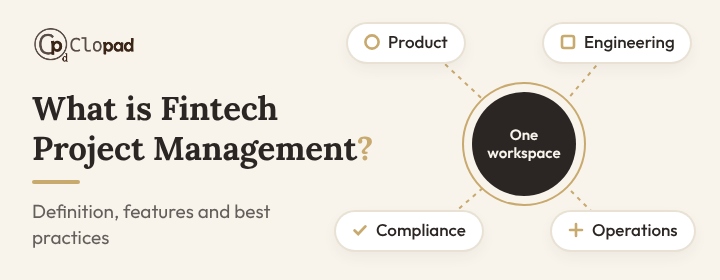
Fintech project management is the structured coordination of product, engineering, compliance, and
operational work within a financial technology organisation. It goes beyond task tracking – it encompasses
workflow visibility, regulatory accountability, cross-team collaboration, and an auditable record of every
decision made across a project lifecycle.
Where general project management focuses on delivery and efficiency, fintech project management adds two
non-negotiable dimensions: regulatory compliance and audit readiness. Every
task, approval, and status change may need to be evidenced and explained to a regulator. That changes how
projects must be structured, tracked, and handed off between teams.
The key distinction
General project management asks: did we deliver on time? Fintech project management also asks: can we
prove how every decision was made, who approved it, and when? Those are fundamentally different questions
– and they require different tools.
Why fintech project management is different
Most project management platforms were designed for marketing teams, agencies, or software companies
operating without regulatory scrutiny. Fintech organisations have a different operating environment:
- Regulatory bodies require documentation of compliance obligations and how they were met
- Multiple teams – product, engineering, compliance, risk, operations – must coordinate on the same
deliverables - Security and data governance mean that not every team member should see every project
- Audit trails must be tamper-evident and exportable, not just a version history
- Compliance tasks cannot be treated as optional or secondary to engineering delivery
When these requirements are handled through generic tools and workarounds, coordination cost grows. Teams
spend more time aligning on status than delivering work. Compliance becomes a gate at the end of the process
rather than a thread throughout it.
Core features of fintech project management software
A platform built for fintech project management should cover the full lifecycle of how regulated teams plan,
execute, and evidence their work. These are the capabilities that matter most.
Task and ticket management
Fintech teams manage multiple work types simultaneously: development tickets, compliance action items,
operational requests, and product backlog items. A purpose-built platform unifies all of these into a single
task management system with configurable workflows, dependencies, and ownership assignment.
Unified task types
Dev tickets, compliance tasks, and ops requests in one view with shared visibility.
Task dependencies
Map blockers and handoffs between teams so nothing falls through between engineering and compliance.
Clear ownership
Every task has an assignee, due date, and accountability trail from creation to completion.
Flexible views
Kanban, list, and sprint views so each team sees work in the format that suits how they operate.
Compliance workflows
Compliance in fintech is not a department – it is a thread that runs through every project. Effective fintech
project management embeds compliance obligations directly into the project workflow so that KYC checks, AML
reviews, SAR filings, and regulatory reporting cycles are tracked alongside development work rather than
managed separately.
This means configurable workflow templates for common compliance obligations, SLA tracking with escalation,
and evidence capture at each workflow step – all within the same platform used by engineering and product.
Why this matters in practice
When compliance obligations live outside the main project workflow, they are often discovered too late in
the delivery cycle. Building them in from sprint planning prevents last-minute sign-off delays and ensures
regulatory evidence is captured as work happens, not reconstructed after the fact.
Audit trails
A tamper-evident audit trail is one of the most important capabilities in any fintech project management
platform. Every task update, status change, comment, access event, and approval should be automatically logged
with a timestamp and attributed to the team member who performed the action.
This record serves two purposes: operational accountability within the team, and evidential documentation for
regulatory examination. The audit log should be exportable and comprehensive enough to answer the question
regulators most often ask – who knew what, when did they know it, and what did they do about it.
See how Clopad manages fintech project workflows
Audit trails, compliance workflows, and team visibility – built in from day one.
Role-based access control
In fintech, visibility is not a feature – it is a governance decision. Not every team member should see every
project, document, or task. Role-based access control allows organisations to configure exactly who can view,
edit, or approve work across different project types and team roles.
This is especially important when external auditors, third-party vendors, or board-level stakeholders need
controlled access to specific project documentation without exposing the full operational workspace.
How fintech project management works across teams
One of the defining challenges of fintech project management is that multiple teams with different cadences,
vocabularies, and accountability frameworks must coordinate on shared deliverables. Here is how a
purpose-built platform supports each team differently.
Product teams
Product managers use fintech project management software to plan and manage roadmaps, coordinate development
cycles, and ensure that compliance obligations are scoped into features before engineering begins. The roadmap
connects to sprint planning, which connects to individual tickets, giving product teams a thread from strategy
to execution.
Engineering teams
Engineering teams need ticket management that integrates with their sprint workflow, tracks dependencies, and
surfaces blockers early. Fintech-specific sprint planning accounts for compliance handoffs – tasks that cannot
be closed until a compliance team member has reviewed and signed off – rather than treating engineering
delivery as the only definition of done.
Compliance teams
Compliance teams benefit most from structured workflows with defined steps, evidence capture, and SLA
tracking. A task assigned to a compliance function should carry the context from the engineering ticket that
created it, so that the compliance review has the information it needs without requiring a separate briefing.
Leadership and operations
Leadership teams need a project view that aggregates across all teams without requiring them to understand
the detail of each sprint or ticket. Real-time dashboards showing project health, team completion rates, and
compliance status give executives the visibility they need to make decisions – without adding to the reporting
burden on the teams delivering the work.
Best practices for fintech project management
- Embed compliance from sprint planning, not sign-off. Compliance tasks should be scoped
and assigned at the start of a sprint, not discovered at the end. Build compliance ticket creation into the
definition of ready for any feature that touches regulated data or processes. - Use one platform for all task types. The coordination cost of managing development
tickets, compliance obligations, and operational requests in separate tools compounds over time. A single
platform with shared visibility eliminates the status update meetings that exist to bridge the gap between
systems. - Define ownership before work begins. Every task should have one assigned owner, a due
date, and a clear definition of done that includes any compliance requirements. Shared ownership and vague
completion criteria are the two most common causes of compliance failures in project delivery. - Treat the audit trail as a product. The audit trail is not a byproduct of good project
management – it is a deliverable in its own right. Configure your platform to log the events that regulators
care about, and review the audit log periodically as part of your compliance programme, not only when an
examination is scheduled. - Give leadership a dashboard, not a report. Static weekly reports go stale immediately.
Real-time dashboards that aggregate project status, team velocity, and compliance progress give leadership
the visibility they need to intervene early when projects drift, rather than discovering issues at the end
of a quarter.
Frequently asked questions
financial technology teams to organise projects, track tasks, manage compliance workflows, and
maintain
a full audit trail of project activity. Unlike general project management tools, it is built for the
regulatory and operational requirements of regulated industries.
allocation. Fintech project management adds compliance workflows, audit trails, role-based access
control, and regulatory accountability as core requirements rather than optional add-ons. The tools
and
workflows must support the specific governance needs of regulated financial services environments.
a tamper-evident audit trail, role-based access control, real-time project dashboards, sprint
planning
tools, and cross-team visibility. The best platforms integrate all of these in a single workspace
rather
than requiring separate tools for each function.
management habits from the outset scale more efficiently and avoid the technical and compliance debt
that comes from managing projects in spreadsheets and general tools. A free plan allows startups to
start structured without upfront cost.
management, compliance workflow templates, automatic audit trails, role-based access control, and
real-time dashboards in a single platform. Teams across product, engineering, compliance, and
operations
can manage their work in one shared workspace without the fragmentation of multiple tools.